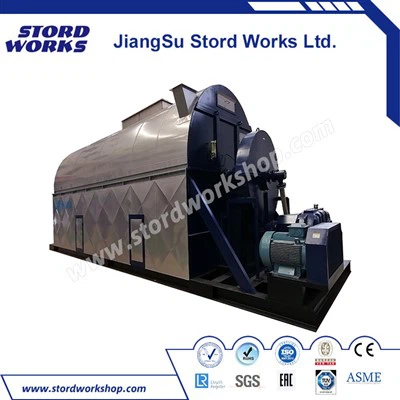
If you're in the market for industrial drying equipment, chances are you've stumbled on tube bundle dryers-workhorses across sectors from food processing to rendering. Let's cut to the chase: one of the most common questions I get from customers is how air temperature impacts drying rate in these units, and how to tune it for maximum efficiency without wasting energy. As a supplier who's installed dozens of these dryers over the years, I've seen firsthand that this isn't just a casual observation; it's rooted in basic heat and mass transfer principles, with real-world implications for your bottom line.
First, let's break down what a tube bundle dryer even does, for anyone new to the space. These dryers use a series of hollow, heated tubes arranged in a rotating or stationary bundle, usually encased in a sealed chamber. The material to dry-whether it's cassava starch, poultry rendering waste, or agricultural byproducts-flows over the outer surface of the tubes. The tubes transfer heat to the wet material, and the evaporated moisture is pulled out of the chamber via a vent or vacuum system, depending on the model. Unlike other dryers that blast hot air directly through the material, tube bundle dryers rely on conductive heat transfer from the tubes, with air temperature playing a key supporting role in moving that moisture out.
So, how does air temperature tie into all this? Let's start with the core physics. Drying works by two key steps: first, heat must transfer to the wet material to turn liquid moisture into vapor, and second, that vapor has to move away from the material's surface so fresh, drier air can take its place. Air temperature directly impacts both steps.
At its simplest, the driving force for drying rate is vapor pressure difference. The wet material has a certain vapor pressure at its surface, and the air inside the dryer chamber has a different vapor pressure. The bigger that gap, the faster moisture escapes. Air temperature affects this in two big ways: warmer air can hold more moisture (its saturation vapor pressure rises exponentially with temperature, not linearly), and warmer air has higher kinetic energy, so it can pick up and carry vapor away from the material faster.
Wait, but let's get specific to tube bundle dryers, because this isn't a convection dryer where air is the main heat source. In a tube bundle dryer, the tubes provide most of the conductive heat, but the air inside the chamber is the medium that transports evaporated moisture out. So if your air temperature is too low, even if the tubes are hot, the air can't hold as much vapor, and it can't move moisture away quickly. That creates a bottleneck: moisture builds up right next to the material, slowing the drying rate way down.
I've seen this play out with a client who was drying poultry rendering waste a couple years back. They tried running their dryer at a lower air temperature to save energy, thinking the hot tubes were enough. But their cycle time went up by 25%, and they ended up with inconsistent final moisture content because the air couldn't pull the moisture off the surface fast enough. Once they bumped the chamber air temperature just 15°F, their drying rate jumped-they got the same moisture finish in 20% less time, and didn't have to crank up the tube heat at all. That's a win-win: faster drying without extra energy use on the heating elements.
But here's the catch: it's not just "the higher the air temperature, the better." There's a sweet spot, and pushing air temperature too high can backfire, especially depending on what you're drying. For example, if you're dealing with heat-sensitive materials like some food starches or pharmaceutical ingredients, too-hot air can cause surface burning, which ruins the product. Even for tougher materials, like abattoir waste or grain byproducts, going too high can lead to uneven drying-outer layers dry fast, trapping moisture inside, which requires longer cycles or extra processing later.
Let's talk about how this plays out across different tube dryer applications, to make it concrete. Take the Cassava Starch Tube Dryer, for example. Cassava starch is temperature-sensitive-if it gets too hot, it can break down or clump, ruining its quality for food or industrial use. In these dryers, we typically set chamber air temperature between 120–140°F, paired with tube surface temps around 200–220°F. That's enough to keep the air holding moisture without damaging the starch, and the drying rate is optimal because the air carries vapor away before it can accumulate on the starch granules. If we cranked the air temp to 160°F, the starch would start to discolor and lose its gelatinization properties, which would make it unusable for most customers.
On the flip side, Poultry Livestock Abattoir Waste Rendering Dryer material is a bit more forgiving-it's high in fat and protein, so it can handle a bit higher air temps. For these units, we usually run air temp between 140–160°F, with the coil tubes heated to 230–250°F. Here, the higher air temp helps strip moisture from the fatty waste, which can be a slower-drying material because of the fat coating. We tested a model where we kept air temp at 170°F, but we saw that while drying rate went up initially, some of the lighter volatile compounds in the waste started to evaporate too, which affected the quality of the final rendered meal. So we found that 150°F was the sweet spot for balancing speed and product quality there.
Another point: vacuum tube dryers, like the Horizontal Batch-type Vacuum Dryer, work a little differently. In vacuum conditions, the boiling point of water drops, so you don't need as much heat to turn moisture to vapor. Here, air temperature is still a factor, but the role shifts a bit because the low pressure does most of the work to pull vapor away. In these units, we adjust air temperature to match the vacuum level: if you're running a deep vacuum (29 inHg), air temp can be lower, around 100–120°F, because the vacuum is already driving the vapor out. If you're running a shallower vacuum (25 inHg), you need a bit higher air temp, 110–130°F, to give that extra driving force to move moisture. We worked with a pharmaceutical client using one of these vacuum dryers, and they were struggling with long cycle times. Adjusting the air temp paired with their vacuum setting cut their cycle time by 18% without any product degradation, which saved them thousands in labor and energy costs.
Now, let's get into the numbers to back this up, not just anecdotes. Studies in industrial drying show that for conductive dryers like tube bundle units, drying rate increases roughly linearly with air temperature up to a saturation point-usually 10–20°F above the material's critical temperature (the temp where it starts to degrade). Beyond that point, drying rate either plateaus or drops, because the excess heat doesn't add more vapor-holding capacity to the air, and it can cause material damage. For most non-heat-sensitive materials, that sweet spot is 130–160°F of air temp, paired with tube temps 80–100°F higher.
Wait, but what about humidity? Oh right, if your incoming air is already humid, you need a higher air temp to get the same drying rate, because the air can't hold as much extra moisture. That's a big one for clients in humid climates-say, a facility in the Southeastern U.S. drying grain. If you're in a dry climate, 130°F air temp is enough, but in a humid area, you might need to bump it to 140–150°F to overcome the ambient humidity. That's something we always factor in when we set up a dryer for a new customer; we ask about their location, the material, and their desired final moisture content to tune the air temp correctly.
Let's also compare to other dryers, like the Paddle Dryer, which is another conductive unit. Paddle dryers use agitation from paddles to mix material, so their heat transfer is a bit more uniform, but the air temp still plays a similar role. The main difference is that tube bundle dryers have a larger surface area, so they can handle more material, but the air temp sweet spot is almost identical. We've found that clients who switch from paddle dryers to tube bundle dryers often have to adjust their air temp settings-usually dialing it down a bit, because the tube bundle's higher heat transfer means you don't need as warm air to get the same drying rate.
Now, common mistakes I see customers make. Number one: running air temperature too low to save energy. They think, "The tubes are hot, so I don't need warm air." But that leads to longer cycles, more energy spent running the dryer for hours longer, and inconsistent product. Number two: running air temperature too high, leading to product damage or wasted energy. It's a balance, and that's where experience as a supplier helps-we can help you find that sweet spot based on your specific material and needs.
Another factor to mention: air circulation inside the tube bundle dryer chamber. Even if your air temp is perfect, if the air isn't moving evenly across all the tubes and material, you'll have hot spots and cold spots, leading to uneven drying. That's why we design our dryers with adjustable air flow fans, so you can tune both temp and circulation. For example, in a Cassava Starch Tube Dryer, we set the fans to blow air at 100 CFM per square foot of tube surface, paired with 130°F air temp, which gives uniform drying across the entire batch.
So, putting this all together: air temperature is a critical, but not the only, variable that impacts drying rate in tube bundle dryers. It works alongside tube heat, material type, vacuum level (if applicable), and air circulation. The sweet spot depends on whether your material is heat-sensitive, the ambient humidity of your location, and your desired cycle time. Pushing temp too low slows drying, wasting energy and time; pushing it too high damages product and wastes energy.


If you're looking to upgrade your drying process, whether you're handling poultry rendering waste, cassava starch, or any other material, our team can help you find the right tube bundle dryer setup with optimized air temperature settings. We've got a range of solutions, from batch units like the Horizontal Batch-type Vacuum Dryer, to continuous models tailored to industries like rendering and food processing.
Ready to talk through your drying challenges and find the right equipment for your operation? Reach out to our team to start a procurement and efficiency discussion.