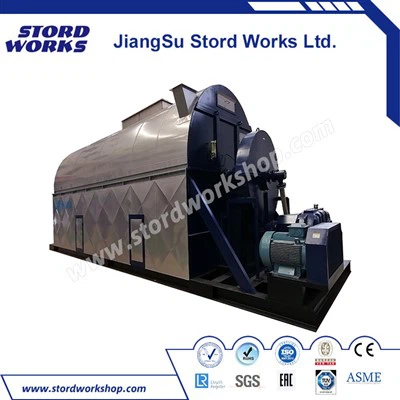
If you've ever walked past a processing plant at dawn-say, a grain mill, a starch refinery, or a biofuel facility-you might have spotted a fine, powdery cloud hanging in the air near the drying section. For years, rotary tube dryers have been the go-to workhorse for moving heat-sensitive, bulk materials through continuous drying processes, but one question that keeps popping up (from plant operators, maintenance teams, and even new engineers) is this: Does a rotary tube dryer produce a lot of dust during operation?
As a supplier of industrial drying equipment, I've spent the last 12 years working alongside these dryers, troubleshooting dust-related headaches, and refining designs to cut down on airborne particulates. The short answer? It depends. A poorly operated or outdated rotary tube dryer can absolutely generate excessive dust-but a properly engineered, maintained, and operated unit will keep dust levels well within safe, regulatory limits. Let's break this down, from how the dryer works to the steps we take (and you can take) to control dust, with real-world examples from the materials we dry most often.
First, let's remind ourselves how a standard rotary tube dryer works, because dust starts where the process does. Most rotary dryers use a slightly inclined, rotating cylindrical shell. Wet material is fed into one end, while a stream of hot gas (air or inert gas, depending on the material) flows either co-current (same direction as the material) or counter-current (opposite direction). As the shell rotates, internal lifter plates lift the material and shower it through the hot gas stream-this is where drying happens fast, but it's also the point where dust can become a problem. The showering action exposes more surface area to heat, which evaporates moisture quickly, but fine particles that break off from the bulk material can become entrained in the gas flow, turning into airborne dust.
So why do some rotary dryers produce way more dust than others? The answer boils down to four key factors: material properties, design choices, operating parameters, and dust collection systems. Let's tackle each one.
Material properties are the biggest starting point. Materials like DDGS (distillers' dried grains with solubles), starch, and alcohol-derived residues are prone to dustiness because they have irregular, brittle particles that break apart easily when agitated. We often get asked about drying these materials, and for each, we have tailored designs. For example, DDGS is a byproduct of ethanol production, and its particles are fibrous and prone to abrasion, which means even gentle agitation can create fine dust. That's why our DDGS Tube Bundle Dryer is optimized with larger, more gradual lifters instead of sharp, aggressive ones-this reduces particle breakage during the showering process. Starch, on the other hand, is much more delicate; its particles are small, round, and prone to clumping when wet, so we adjust the gas velocity to prevent entraining fine starch dust while still drying efficiently. Our New Starch Tube Bundle Dryer uses a lower-velocity co-current gas flow and a pre-conditioning step to stabilize starch particles before they enter the rotating shell, cutting dust generation by up to 40% compared to standard rotary dryers for starch.
Design choices make a huge difference in how much dust escapes the dryer. Early rotary dryers used large inlet and outlet openings, and the rotating shell left a small gap around the inlet seal that gas and dust could leak through. Today's engineers have fixed that with more precise seal designs-like labyrinth seals and air purge seals that create a barrier between the rotating shell and the stationary inlet/outlet hood. We've also shifted away from some older lifter designs that shower material too violently. For high-capacity operations, our High Capacity Tube Bundle Dryer uses a series of staggered, curved lifters that lift material in slow, controlled curtains instead of dense, forceful clouds. This keeps most particles attached to the bulk or falling back into the dryer, rather than becoming entrained in the exhaust gas. Another design tweak we've added is a "dust suppression zone" near the dryer outlet: a section where the gas flow slows down and a light mist of process water (or recycled condensate) is sprayed. This mist binds with fine dust particles, making them heavy enough to fall back into the dryer instead of heading to the collection system. That's a game-changer for materials like alcohol residues, which are both dusty and slightly sticky-our Alcohol Tube Bundle Dryer integrates this zone as a standard feature, cutting exhaust dust levels by 60% for many ethanol producers we work with.
Operating parameters are another easy way to reduce dust, even if you have an existing dryer. Operators often make the mistake of cranking up gas velocity to speed up drying, but higher velocity means more drag on particles, pulling them into the exhaust. We tell plant operators to match gas velocity to the material's particle size: fine, dust-prone materials need lower velocity, while larger, heavier particles can handle slightly higher flow. Also, feeding material too quickly into the dryer causes overloading, which means the lifters can't move material smoothly, leading to more particle breakage. Spreading the feed rate evenly (using a variable speed feeder) keeps the material bed consistent, reducing dust. I recently worked with a small grain processing plant that was seeing 120 mg of dust per cubic meter in their exhaust-well over the 50 mg/m³ limit in their area-just by adjusting the feed rate and cutting gas velocity by 15%. Within a week, their dust levels dropped to 38 mg/m³, and they didn't have to buy any new equipment.
But even with the best design and operating practices, you still need a good dust collection system. A dryer is only as good as its exhaust handling, and a high-efficiency cyclone or baghouse is non-negotiable. Many older dryers use basic cyclones that only catch 60-70% of fine dust, letting the rest escape. We pair our tube bundle dryers with pulse-jet baghouses that capture 99.5% of airborne particles. For materials that are explosive-like starch or DDGS-we use spark detection systems in the exhaust line that shut down the gas flow immediately if a spark is detected, and we keep oxygen levels low in the system to prevent dust explosions. I once visited a plant that had a small dust explosion because their old cyclone wasn't catching fine starch dust, which accumulated in the ductwork over time. Since they switched to our New Starch Tube Bundle Dryer with a pulse-jet baghouse, they haven't had a single issue, and their plant is OSHA-compliant now.
Of course, there are exceptions. If you're drying a material like fine alumina or pigment, which has extremely small, abrasive particles, you'll still see some dust, but it's manageable with the right setup. For heat-sensitive materials like pharmaceuticals, we use low-temperature drying modes that reduce particle breakage and dust. The key takeaway is that "excessive dust" isn't an unavoidable side effect of rotary tube dryers-it's a result of bad design, poor operation, or outdated equipment.
If you're struggling with dust from your current rotary tube dryer, here's what you can do: First, get your dust levels tested by a third-party lab to know exactly how much you're producing (many local environmental agencies offer free or low-cost testing for industrial plants). Then, check your operating parameters: is your feed rate too high? Is your gas velocity set correctly? Finally, if your dryer is more than 15 years old, it might be worth upgrading to a modern tube bundle dryer, which has the seals, lifters, and dust control features we've talked about. Our Steam Tube Bundle Dryer is a popular choice for facilities switching from old rotary dryers because it uses steam as a heat source (lowering energy costs too) and has all the dust-reduction features we've refined over the last decade.
As a supplier, I've learned that the best solutions aren't one-size-fits-all. A starch refinery has different needs than a DDGS plant, and a pharmaceutical processor needs even more care. That's why we work closely with each customer to tailor our dryers to their specific material, space, and dust requirements. We don't just sell equipment-we help you cut dust, meet regulatory standards, and keep your plant running safely.
If you're ready to stop dealing with excess dust from your drying process, or you just want to learn more about how our tube bundle dryers work, reach out to our team for a consultation. We'll walk you through your options, share data from similar operations, and help you find a solution that fits your needs and budget.