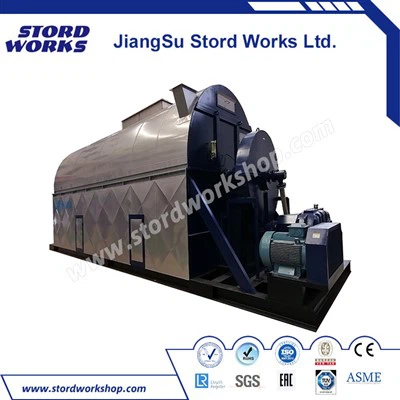
If you've ever worked in industries like agriculture, bioenergy, or food processing, you know that consistent moisture content is make-or-break for product quality-and that's where drying uniformity becomes non-negotiable. When it comes to bulk, heat-sensitive materials, a Tube Bundle Drum Dryer stands out as a workhorse, but what really defines its drying uniformity, and why does it matter more than raw drying speed? As a supplier who's walked plant floors with engineers and operators for over a decade, I've seen first-hand how uneven drying can ruin batches, waste energy, and leave customers frustrated. Let's break down what drying uniformity means for this equipment, how it's measured, and why it's a key reason our clients choose our machines over other drying solutions.
First, let's get clear on what a Tube Bundle Drum Dryer actually is, because its design is the foundation of its uniformity. Unlike direct rotary dryers that blow hot air through a cascading material bed (which can lead to hot spots or air gaps), tube bundle dryers use a rotating drum packed with horizontal, steam-heated tubes. As the drum turns, material cascades over these tubes, transferring heat evenly across the entire bed-no more exposed patches of material missing heat, or overheated areas that burn delicate particles. If you're looking for a machine built specifically for high-uniformity drying, our Tube Bundle Drying Machine is engineered to adjust to your material's flow rate, so even fine, sticky, or bulky products get consistent exposure.
Drying uniformity isn't just a vague term-it's a measurable metric, usually expressed as the coefficient of variation (CV) of moisture content across a dried batch. The CV is the standard deviation of moisture readings divided by the average moisture content, with a lower CV meaning more uniformity. For most industrial applications, a CV below 5% is considered excellent, but some industries like DDGS (distillers' dried grains with solubles, a byproduct of ethanol production) require even tighter uniformity because variations in moisture affect pellet durability and storage life. Our DDGS Tube Bundle Dryer is designed with variable-speed controls and adjustable material lifters to hit that low CV consistently-last year, a midwest ethanol plant switched to ours and cut their moisture CV from 8.2% to 3.1%, reducing rework and extending product shelf life by 2 weeks.
So, what factors actually impact the drying uniformity of a tube bundle dryer? Let's start with tube design. The diameter, spacing, and steam pressure in the tubes all play a role. If tubes are too far apart, material falls through gaps without making full contact with a heat source, leading to under-dried chunks. If they're too close, material can get stuck in the gaps, causing over-drying or clumping. Our High Quality Tube Bundle Dryer features precision-engineered tube arrays spaced to match the specific particle size of your material-for DDGS, we use 2-inch tube spacing, while for finer grains like corn germ, we go with 1.5 inches. Steam pressure is another key: we let clients adjust pressure from 5 to 15 PSI, so you can dial in the heat to match your material's heat sensitivity, preventing scorching that would ruin uniformity.
Another big factor is material handling and drum rotation speed. If the drum turns too fast, material doesn't have time to cascade over the tubes evenly-pieces at the top get over-heated, while pieces at the bottom stay in contact too long. If it turns too slow, the bed becomes stagnant, with no fresh material moving past the heat source. The rotary steam tube bundle dryers we supply have a variable frequency drive (VFD) that lets operators fine-tune rotation speed in real time. We worked with a rice mill in Asia a few years ago that was struggling with uneven drying on broken rice kernels-adjusting the drum speed from 2 RPM to 1.2 RPM fixed the issue, dropping their CV by 4 percentage points. That's the kind of adjustment only a machine with flexible controls can offer.
Wait, but what about load size? A lot of operators assume "run as much as possible to cut costs," but overloading a tube bundle dryer is a surefire way to kill uniformity. When the bed is too thick, heat can't penetrate to the bottom layers, leaving under-dried material at the core. Our Industrial Tube Bundle Dryer comes with load sensors that alert operators if the material bed depth exceeds the optimal range (usually 60-70% of the tube height), so you don't have to guess. We've seen clients who tried to cram 20% more material into their old dryer end up with 3x higher moisture CV than when they ran at the correct load.
Now, let's talk about why drying uniformity matters beyond just product quality. For operators, uniform drying means less waste. If 10% of your batch is under-dried, you have to re-run it, which doubles energy use and labor costs. If it's over-dried, those particles are brittle and break during transport, reducing your sellable product. For example, a corn starch plant we supply reported that after switching to our tube bundle dryer, their product waste dropped from 7% to 2%-saving them over $150,000 a year in raw material and energy costs.
Another point: consistency makes downstream processing easier. If your material is uniform in moisture, pelleting, milling, or packaging runs smoothly-no machine stoppages from clumps or broken particles. That's why many of our clients prioritize uniformity over raw drying rate; a dryer that runs slightly slower but produces a uniform batch will save more money in the long run than a fast one that wastes material.
But not all tube bundle dryers are created equal. Cheaper models from overseas often use fixed tube spacing and no VFD, so uniformity is hit-or-miss. Last year, a client came to us after their $50,000 budget dryer was producing a 12% moisture CV, leading to 20% waste. We retrofitted it with our precision tube array and VFD controls, and dropped their CV to 4.5% in a week-for a fraction of the cost of a new dryer. That's the value of working with a supplier who understands that uniformity isn't an afterthought, it's part of the design.
So, how can you test the uniformity of your current tube bundle dryer? The simplest way is to take 10-15 samples across different points in the drum (top, middle, bottom, and different ends) and measure their moisture content. If the variation is more than 5%, it's time to look at adjustments-tube spacing, rotation speed, or load size. If those don't fix it, you might need to upgrade your controls or tube design.
At the end of the day, drying uniformity is the quiet advantage of a Tube Bundle Drum Dryer over other drying technologies. It's not just about drying material-it's about drying it evenly, consistently, and without wasting time or money. Whether you're processing DDGS, grains, distillers' grains, or other industrial materials, a machine built with uniformity in mind will pay for itself in lower waste, higher product quality, and smoother operations.
If you're struggling with drying uniformity on your current equipment, or looking to upgrade to a machine that delivers consistent results, we're here to help. We can walk you through your material requirements, show you how our machines hit those low CV targets, and answer any questions you have about design, installation, or performance. Reach out to our team to start a conversation about your drying needs.