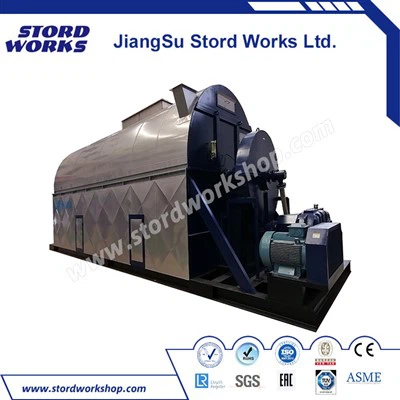
If you've ever walked through a processing plant that handles bulk materials-whether rendering plant byproducts, agricultural residues, or food manufacturing intermediates-you've likely passed equipment designed to remove moisture efficiently without damaging the product. The industrial tube bundle dryer is one such workhorse, and its core function hinges on a component that often goes overlooked but is critical to performance: the air distribution system. As a supplier of these dryers, I've spent countless hours with plant operators, engineers, and maintenance teams talking about what makes these systems work-and what happens when they don't. Let's break down exactly what the air distribution system in an industrial tube bundle dryer is, how it operates, and why it's the backbone of reliable, high-capacity drying.
First, let's ground ourselves in the basics of a tube bundle dryer itself. Unlike direct dryers that blast hot air directly onto material, tube bundle dryers use indirect heat: a series of hollow, heated tubes (usually filled with steam, hence the common name steam tube bundle dryer) transfer thermal energy to the surrounding material as it moves through the dryer shell. The air distribution system's job is to circulate the air inside the shell to pick up that heat, carry away evaporated moisture, and ensure every particle of material gets consistent exposure to the heated tube surfaces. Without this system, even the most perfectly engineered tube bundles can leave wet spots on your product, waste energy, or force you to slow production.
So what does an industrial air distribution system for this type of dryer actually consist of? It's not a single part-it's a network of components designed to balance airflow, manage heat and moisture, and adapt to different material types. Let's start with the core parts: the air inlet chamber, baffles, exhaust fans, and air flow regulators. Each has a specific role, and getting their design right is what separates a dryer that runs smoothly from one that causes headaches.
The air inlet chamber is where fresh, heated air (or sometimes recirculated air, depending on the process) enters the dryer shell. This isn't just an open hole-its shape is engineered to distribute air evenly across the entire cross-section of the tube bundle. If air rushes in unevenly, some sections of the dryer will get too much airflow (wasting energy) and others too little (leaving material under-dried). For example, when we designed the tube bundle dryer for a rendering plant, our team adjusted the inlet chamber's angle to match the flow of protein meal moving through the shell, preventing dense, heavy byproducts from settling in low-air zones.
Next come the baffles-arguably the most important part of the system. Baffles are metal plates mounted inside the shell that guide the air's path as it flows around and between the heated tubes. In most tube bundle dryers, the material moves along the length of the shell (either by rotation for rotary steam tube bundle dryers or by gravity for stationary models), so the air needs to flow in a counter-current direction to maximize heat transfer. A counter-current setup means the driest material meets the hottest, moisture-laden air, which is a far more efficient setup than co-current (where material and air move in the same direction). Baffles ensure this counter-current flow is maintained, creating a spiral or zig-zag air path that forces air to stay in contact with both the tubes and the material for longer. That's a key detail: if baffles are poorly placed, air shortcuts through the dryer, and you lose up to 20% of heat transfer efficiency (something I've seen first-hand in older, poorly maintained dryers).
Then there's the exhaust side. The air distribution system includes exhaust fans that pull moist air out of the shell, creating the slight negative pressure needed to keep fresh air flowing in through the inlet. These fans aren't one-size-fits-all: for delicate materials like corn fiber, a high-velocity fan can blow lightweight particles out of the dryer, so we design the air distribution system for the corn fiber tube bundle dryer with a variable-speed exhaust fan that adjusts airflow based on moisture levels. That way, we remove excess moisture without wasting product.
Now, how does this system adapt to different types of tube bundle dryers? Let's talk about the two most common configurations: rotary steam tube bundle dryers and stationary tube bundle dryers. The rotary model uses a rotating shell, so the air distribution system has to account for the shell's movement. Baffles in rotary dryers are often curved to follow the shell's rotation, preventing material from being carried upward without interacting with the air. In contrast, stationary dryers (like those used in some rendering plants) have fixed baffles, so the air path is more linear but still optimized for counter-current flow. Even within rotary models, there are differences: the rotary steam tube dryer (a slightly different variant) uses a rotating tube bundle instead of a rotating shell, so its air distribution system is mounted on a stationary inlet and outlet, with baffles tailored to stay in place regardless of rotation.
What about the science behind how this system affects drying performance? Let's get a bit technical, because operators need to understand why small changes in air distribution matter. Drying rate depends on two main factors: heat transfer (from the tubes to the material) and mass transfer (from the material's surface to the air). The air distribution system directly impacts both. If airflow is too low, moist air builds up around the material, creating a "boundary layer" that slows mass transfer-like trying to dry a wet cloth in a still room vs. a windy one. If airflow is too high, it can cool the tubes (since air that's too cold will absorb more heat from the tubes than needed) or blow material out of the dryer. The sweet spot is a uniform air velocity (usually between 1 and 3 meters per second, depending on material) that removes moist air quickly without disrupting the material bed.
This is where our role as a tube bundle dryer supplier comes in. We don't just sell a standard machine-we engineer the air distribution system to match the specific material and production needs. For example, when a rendering plant contacts us, their byproducts (like meat and bone meal) are dense and high in fat, so we adjust the baffle spacing to keep the material bed mixed, ensuring air reaches every particle. For corn fiber, which is lightweight and fibrous, we reduce air velocity and add a dust collection port as part of the exhaust system to prevent product loss. For agricultural materials that are sensitive to high heat, we design the air distribution system to recirculate 50-70% of the exhaust air, mixing it with fresh, cooler air to lower the inlet air temperature while maintaining drying efficiency.
Maintenance is another big part of the air distribution system's role-and a common pain point for plant operators. Over time, dust, scale, and byproduct buildup can clog baffles or air inlets, reducing airflow and drying performance. I've seen operators ignore these issues, thinking it's just "normal wear and tear," but in reality, a 10% blockage in the air distribution system can increase energy costs by 15% and reduce drying capacity by the same amount. That's why we include regular maintenance checks as part of our support for customers: we provide guides on cleaning baffles, adjusting airflow regulators, and inspecting inlet chambers for buildup.
Let's address a common misconception: some operators think that bigger fans mean better airflow, but that's not true for the air distribution system. A powerful fan without a properly designed inlet, baffles, and outlet will create turbulent airflow that's not uniform. Uniformity is everything. For example, in one project I worked on, a customer installed a larger exhaust fan to speed up drying, but their product came out uneven-some sections were too dry, some too wet. The problem was the baffles weren't spaced correctly, so the extra fan power just created more turbulence instead of better air-material interaction. We reworked the air distribution system's baffles, and within a week, their product uniformity improved by 30% and their energy use dropped by 12%.
So how does the air distribution system integrate with the rest of the tube bundle dryer? The heated tubes (whether in a steam tube bundle dryer or rotary steam tube dryer) transfer heat to the air as it flows through the dryer, so the air distribution system's path must be aligned with the tube layout. Tubes are usually arranged in a triangular or square pattern, and baffles are placed between rows of tubes to force air to flow across them-this is called "cross-flow" around the tubes, which maximizes heat transfer. If the air path doesn't match the tube pattern, some tubes will be bypassed, and you're not using your heating capacity to its full potential.
Another key feature is the humidity control in the air distribution system. Modern industrial dryers have sensors that measure air moisture and temperature at the inlet and outlet, which feed into the system's regulators. If exhaust air is too moist, the regulators increase airflow to remove more moisture; if it's too dry (meaning you're wasting energy heating air that can't hold more moisture), they reduce airflow to save steam. This closed-loop control is what makes contemporary tube bundle dryers so efficient, and it's all dependent on the air distribution system being able to adjust airflow quickly and uniformly.
Let's talk about specific use cases to make this concrete. A rendering plant handles byproducts that are high in protein and fat, which can be prone to caking if dried too quickly. The tube bundle dryer for rendering plant we supply has an air distribution system with adjustable baffles that let operators slow airflow during the final drying stage, preventing caking while still reaching the required moisture level. For a corn fiber processing operation, the corn fiber tube bundle dryer has a more delicate air distribution system with a dust extraction vent integrated into the exhaust, so lightweight fiber doesn't get carried away. For large-scale agricultural operations, the rotary steam tube bundle dryer's air distribution system is designed for higher capacity, with longer baffles that cover the full length of the rotating shell, ensuring uniform airflow across thousands of tons of material per hour.
Now, why does this matter for your operation? At the end of the day, the air distribution system is what turns a set of heated tubes into a productive drying process. If it's poorly designed, you'll face high energy costs, uneven product quality, downtime for cleaning, and even product loss. If it's well-engineered, you'll get consistent moisture levels, lower energy use, less maintenance, and higher throughput.
As a supplier, our focus isn't just on selling equipment-it's on making sure that equipment works for your specific needs. That's why we take the time to learn about your material, your production goals, and your pain points before designing the air distribution system (and the rest of the dryer) for you. Whether you need a steam tube bundle dryer for rendering, a corn fiber tube bundle dryer for food processing, or a rotary steam tube bundle dryer for high-capacity agricultural drying, we tailor every component to optimize performance.
If you're experiencing issues with your current dryer's drying uniformity, energy costs, or throughput, the air distribution system is almost certainly a place to start. It's easy to overlook, but its impact on your bottom line is significant. To discuss your drying needs and explore how a properly engineered tube bundle dryer with a custom air distribution system can benefit your operation, don't hesitate to reach out.